- Highspire
- Posts
- The metric that predicts construction profitability
The metric that predicts construction profitability
The metric that shows whether your projects are actually producing profit on time.


Quick recap:
Part 1 covered Overhead Efficiency, which is the foundation of profit.
Now we move to Lever 2: GP/Week, also known as the speed of profit.
Most builders focus on how much they make. The top companies focus on how fast they make it. It doesn’t only measure profit but measures momentum, discipline, and the true health of your schedule.
A company that understands GP/Week can spot operational issues weeks before they show up in gross profit reports.
1. What Is GP/Week
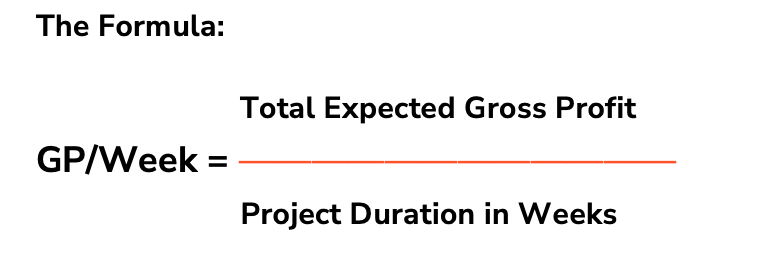
Definition: Gross Profit per Week is the amount of profit you earn for every week a project is active.
It is powerful because it links profit directly to time. Not targets on paper, but the real pace of your operation.
Example:
Your team expects a project to produce $100,000 in gross profit over a 20 week schedule.
That means your target GP/Week is $5,000.
If the project slips and takes 25 weeks instead of 20, GP/Week drops to $4,000.
Insight:
You did not lose revenue. You lost velocity.
The job is profitable on paper, but it produces less profit per week, and that slower pace reduces the number of jobs your company can complete in a year.
2. Why It Matters
Overhead does not pause when production slows.
Those costs continue every week regardless of how fast your sites move.
This is why schedule creep is one of the largest, most silent margin killers in construction. A job can hit its GP target and still damage annual profit if it runs long.
GP/Week exposes this instantly.
When you multiply GP/Week across your entire pipeline, you see the real story:
Your profit is not determined by how many jobs you win.
It is determined by how effectively you turn those jobs over.
It is similar to retail inventory turns. The faster you complete quality work, the more opportunities you create for revenue and net profit.
Companies that maintain a strong weekly earning pace convert effort into results more quickly. That speed compounds year over year.
3. Real Example
Here is a real comparison from two construction companies that were almost identical in size.
10 to 11 million dollars in annual revenue
20 percent gross profit
1.2 million dollars overhead
Company A paid off its annual overhead by August 6th.
Company B paid it off by July 15th.
A difference of only three weeks.
Those three weeks created five and a half months of pure profit for Company B.
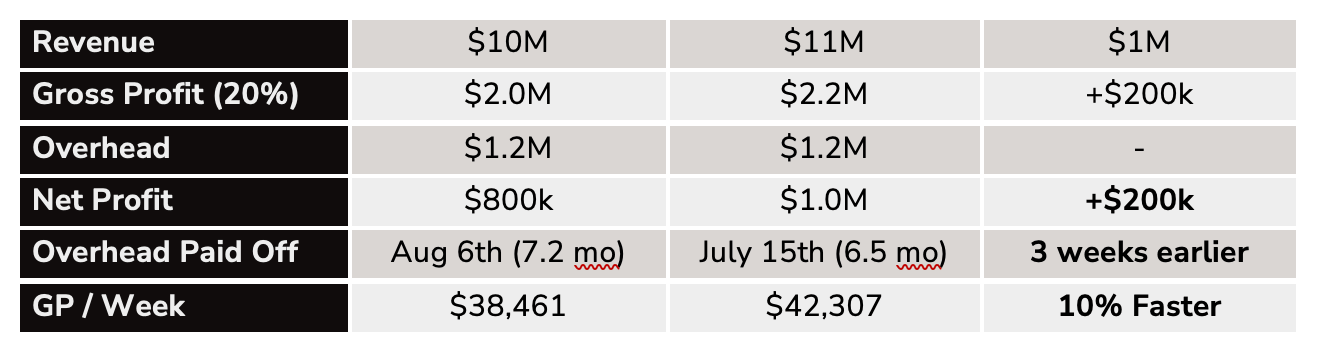
This is the impact of small gains in velocity.
A slightly faster GP/Week creates time. That extra time translates directly into more months of profitability.
Lesson:
Time is the most expensive resource in construction.
GP/Week turns time into a clear and measurable KPI.
4. How to Use GP/Week
Start by tracking GP/Week for every active project.
Make it one of the first numbers reviewed during weekly operations meetings.
Ask your team three simple questions:
What is our expected GP/Week
What is our actual GP/Week
What slowed us down
These conversations change behavior. When teams know their work pace is visible, they manage time, sequencing, crews, and decision making more intentionally.
Tracking GP/Week improves:
Field efficiency
Schedule control
Coordination between teams
Accountability
The ability to predict financial performance earlier
GP/Week brings clarity long before gross profit statements do.
Want to see how to benchmark your GP/Week against top builders?
You cannot improve what you do not measure.
Start tracking GP/Week to reveal where time is leaking profit and where projects slow down without being noticed.
Small gains in weekly pace often create the biggest jumps in net profit.
Get a simple tool to calculate GP/Week across all projects
See how small improvements create major profit gains
Identify where delays and decisions are quietly destroying margin
Next in the Series
Part 3: Pre-Construction Management, the Hidden Profit Lever
We will break down how the most profitable builders control cost, time, and client alignment long before the first shovel hits the ground.
Stay tuned.
Forward always,
Paul Atherton
CEO and Co-Founder, Highspire